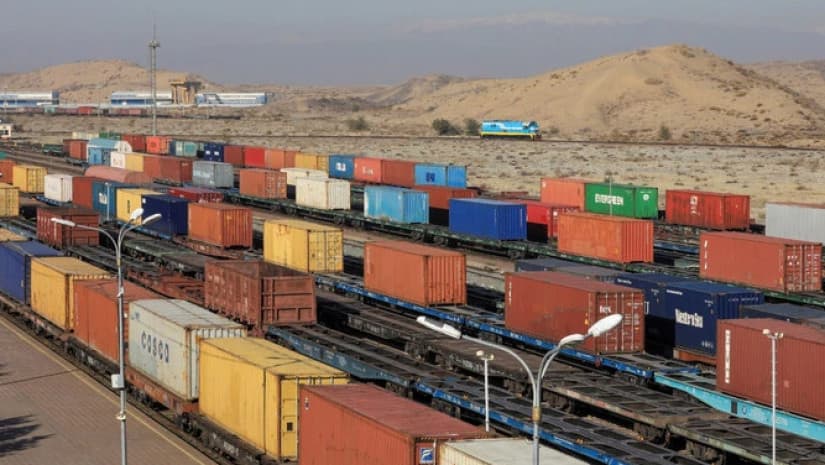
Container traffic on the Middle Corridor continued to grow in 2026. Between January and August, roughly 54,000 TEU of containers were carried along the route, an increase of 11% on the same period last year.
The figures were given by Rashad Mejidov, chief operating officer of ADY Express, a subsidiary of Azerbaijan Railways (ADY), in an interview with Azerbaijani media.
Westbound flows dominate
According to Mejidov, most container shipments on the route run from east to west. In the first eight months of 2026, about 42,000 TEU moved in that direction.
Traffic in the opposite direction, from west to east, amounted to only 10,000 to 11,000 TEU over the same period. Mejidov said that narrowing this imbalance between the two directions is one of ADY's main priorities.
The route in context
The Middle Corridor, also known as the Trans-Caspian International Transport Route, links China and Central Asia with Europe via the Caspian Sea, Azerbaijan and Georgia. In recent years it has gained importance as an alternative transport option for international trade.
For reference, one TEU is equivalent to one 20-foot container.
What it means for investors
An 11% year-on-year rise shows that the corridor's container business is still expanding, and every westbound box on this route passes through Georgia on its way to Europe. The more telling figure, however, is the directional split: roughly four westbound containers for every eastbound one.
For owners and operators of Georgian logistics assets, that imbalance matters. Empty repositioning adds cost to each round trip, and routes that can fill return legs tend to become more competitive over time. If ADY and its partners succeed in growing west-to-east cargo, demand could broaden beyond transit handling towards consolidation, storage and value-added services for goods heading into the Caucasus and Central Asia. Investors assessing port-side terminals, rail-connected land or warehousing in Georgia may wish to track eastbound volumes alongside headline growth.
Source: Commersant.ge, 10 September 2026.