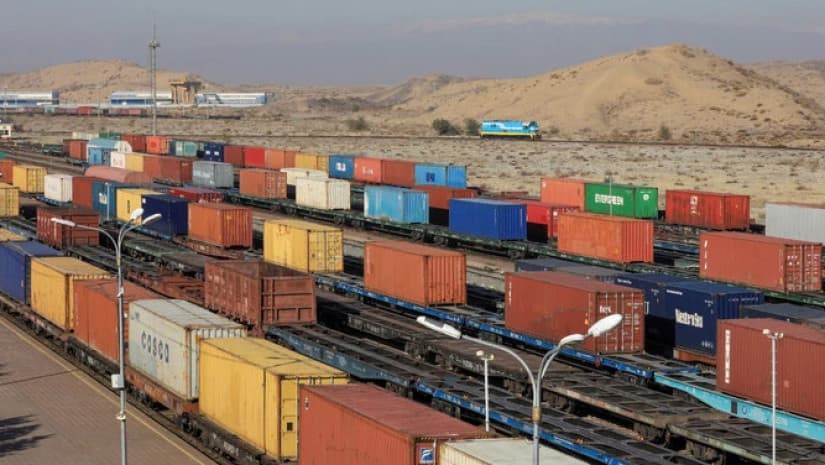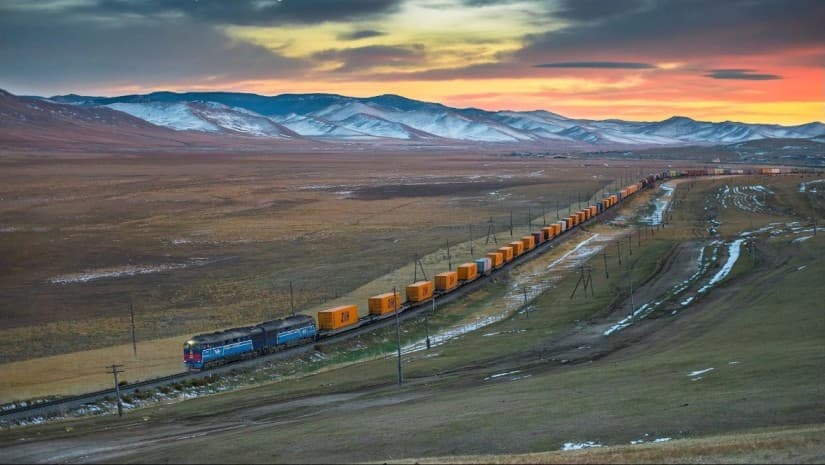
The World Bank has published its most detailed assessment yet of the Trans-Caspian Transport Corridor, better known as the Middle Corridor. Integration: World-Class Trade Logistics Along the Trans-Caspian Transport Corridor, by Muneeza M. Alam and Luis C. Blancas, extends the Bank's 2023 study to all nine host countries, resets the baseline to 2023 and models cargo flows out to 2040. For anyone looking at ports, rail-connected land or logistics real estate in Georgia, it is the most useful single reference on where corridor volumes are likely to go and what stands in the way.
The headline numbers
Under the report's TCTC Development scenario, which assumes the planned infrastructure and equipment investments are delivered, cargo volumes across the corridor grow substantially between 2023 and 2040:
| Segment | 2023 | 2040 | Change |
|---|---|---|---|
| Caspian crossing | 8.8 million tonnes | 32.1 million tonnes | about 3.6x |
| Eastern gateway | 28.5 million tonnes | 105.7 million tonnes | about 3.7x |
| Western gateway (South Caucasus, Türkiye, Black Sea) | 12.1 million tonnes | about 35.0 million tonnes | about 2.9x |
Excluding oil and oil products, growth is steeper still: non-oil volumes rise about 4.5 times at the Caspian crossing (3.5 to 15.6 million tonnes), 4.1 times at the Eastern gateway and 5.1 times at the Western gateway (4.0 to 20.5 million tonnes). The Western gateway, which runs through Georgia, therefore shows the fastest non-oil growth of the three segments.
The report also finds that:
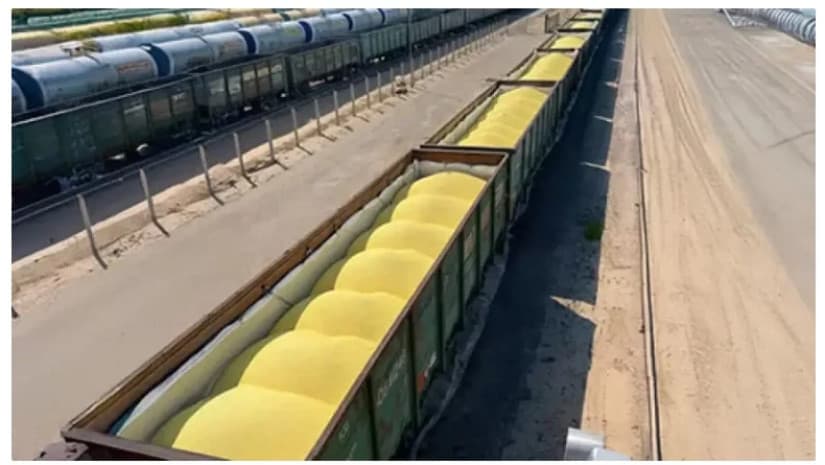
- 92% of freight currently moving across the Caspian Sea is bulk: grain, fertiliser, construction materials and fuels.
- Trade across the host countries is expected to grow 1.5 times in value and 60% in volume between 2023 and 2040 even before corridor improvements, while the share of higher-value cargo rises at every gateway.
- Developing the corridor could lift GDP by 3.3% and employment by 2.9% across the host countries, which the World Bank equates to about 2 million additional jobs by 2040.
Bulk carries the case; containers decide the upside
The report's central argument is that infrastructure is no longer the main constraint. Of the 16 most urgent infrastructure projects it identifies, worth $25.1 billion in total, 75% are already under way or expected to launch in the near term. Because these projects are driven mainly by regional bulk demand rather than uncertain transit flows, the authors consider their economic case robust.
The harder problem is performance. A typical East Asia to Europe container shipment on the corridor today takes 47 to 50 days door to door, against roughly 45 days by sea, and costs more. With reforms to trade facilitation, operations and cross-border collaboration, the report models door-to-door times of 18 to 19 days by 2040. In that case, containerised rail landbridge volumes would be more than twice as large as in a scenario that relies on infrastructure alone. The World Bank's summary puts it more broadly: with infrastructure plus reforms, corridor volumes could quadruple and travel times fall by two-thirds compared with 2023.
The proposed reforms include:
- A single digital transport, transit and trade (T3) document to replace today's paperwork. A typical shipment currently enters and leaves customs transit regimes ten times.
- A joint-venture operator integrating container rail and Caspian shipping services.
- Stronger governance of the state-owned railways, ports and shipping lines.
- A corridor-wide structure to measure performance and coordinate action.
Georgia's ports are the immediate pinch point
The report's findings on Georgia are specific. Poti handles 85% of the country's container throughput and is effectively full:
- 2023: 592,589 TEU handled against 600,000 TEU capacity (99% utilisation).
- 2025: a record 636,466 TEU against capacity raised to about 650,000 TEU by operational measures (98% utilisation).
- Batumi: 109,579 TEU in 2025 against 200,000 TEU of capacity (55%).
The authors describe this as a high congestion risk and an urgent need for port capacity in Georgia. They recommend two responses:
- Short term: an in situ capacity addition at Poti, estimated at $250 million and not yet launched, through equipment and yard optimisation. In the report's 2030 modelling this adds about 200,000 TEU, taking Poti to roughly 800,000 TEU. Better last-mile rail and road access to the port is also suggested.
- Medium term: the $1.2 billion Anaklia deep-water port, expected by the report to become operational in 2029 and to ramp up in the early 2030s. Anaklia is being developed under the landlord model, which the authors note has no precedent in Georgia's general-cargo ports. That allows more than one terminal and more than one operator, and so competition both with Poti and Batumi and within Anaklia itself.
On rail, the report highlights several recent steps:
- Baku-Tbilisi-Kars line: modernised in May 2024, raising its annual capacity from 1 to 5 million tonnes.
- Baku-Poti express block train: launched on 30 January 2026.
- Georgian Railway: about 1,400 km and 13.7 million tonnes a year, with comparatively advanced governance for its size, but an ageing fleet. At the end of 2023, 84% of its locomotives and 86% of its wagons were at least 30 years old.
The report's 2030 scenario assumes the Gardabani border crossing with Azerbaijan expands to about 40 trains a day, with rail connections to Poti and Batumi expanded to about 12 trains a day.
Where the next investment goes
Beyond the $25.1 billion of core projects, of which $22.5 billion is rail, the report identifies an initial $30.5 billion of "economic activity-enabling" investments. These include logistics hubs, intermodal terminals, industrial zones, feeder roads and rolling stock. It considers 66% of this, about $20 billion, open to private participation, mostly toll roads, logistics equipment and terminals.
For Georgia, the enabling list totals about $1.9 billion. It includes:
- road and rail hinterland links to Anaklia ($165 million);
- expansion of the Akhalkalaki gauge-change terminal ($150 million);
- further expansion of the Baku-Tbilisi-Kars line ($300 million);
- a dual-gauge line from Akhalkalaki to the Turkish border ($50 million).
The report cites two recent private projects as the kind of node the corridor needs. One is the Poti TransTerminal, a 9-hectare, 80,000 TEU inland terminal next to Poti port, opened in June 2025 by a joint venture of Kazakhstan Railways and PTC Holding. The other is the Tbilisi Dry Port, opened the same month with investment from AD Ports Group, Wilhelmsen and Inveco as a rail-enabled extension of Poti and Batumi.
What it means for investors
Three points stand out for real-asset investors in Georgia.
- The demand case rests on bulk and regional trade today. That supports land and terminals with direct rail and port access, where volumes do not depend on the corridor winning the harder container landbridge market.
- The container upside is real but conditional on reforms that will play out, in the report's words, over the next 10 to 15 years. Assets positioned around Poti, Anaklia and the inland terminals benefit most if those reforms succeed.
- Capacity at Georgia's Black Sea gateway is the near-term bottleneck. Port-adjacent, rail-served land around Poti and the future Anaklia hinterland sits directly in the path of the expansion the report calls for.
The report is equally clear about the risks:
- Climate exposure: Georgian rail sections, including the approaches to Poti and Batumi near the Rioni river, are exposed to floods and landslides.
- Caspian shipping: a chronic vessel shortage on the Caspian limits end-to-end gains from inland upgrades.
- Institutions: the quality of the state-owned operators will ultimately decide whether infrastructure translates into reliable service.
Questions about rail-connected land or terminal assets in Poti? Contact AssetPorts on WhatsApp or at info@assetports.com.
Source: Alam, Muneeza M., and Luis C. Blancas. 2026. Integration: World-Class Trade Logistics Along the Trans-Caspian Transport Corridor. Europe and Central Asia Studies. Washington, DC: World Bank. License: CC BY 3.0 IGO. This is a summary and adaptation of an original work by the World Bank; views and opinions expressed here are the sole responsibility of AssetPorts and are not endorsed by the World Bank.